Why do some brands become instantly recognizable while others are forgotten just as quickly?
The answer isn’t luck, expensive software, or a talented designer working behind the scenes. Every memorable logo, website, advertisement, and brand identity is built on a set of timeless design principles that shape how people see, understand, and connect with visual content.
These principles act as the invisible framework behind great design. They create balance, guide attention, evoke emotion, and turn individual elements into a cohesive brand experience that leaves a lasting impression.
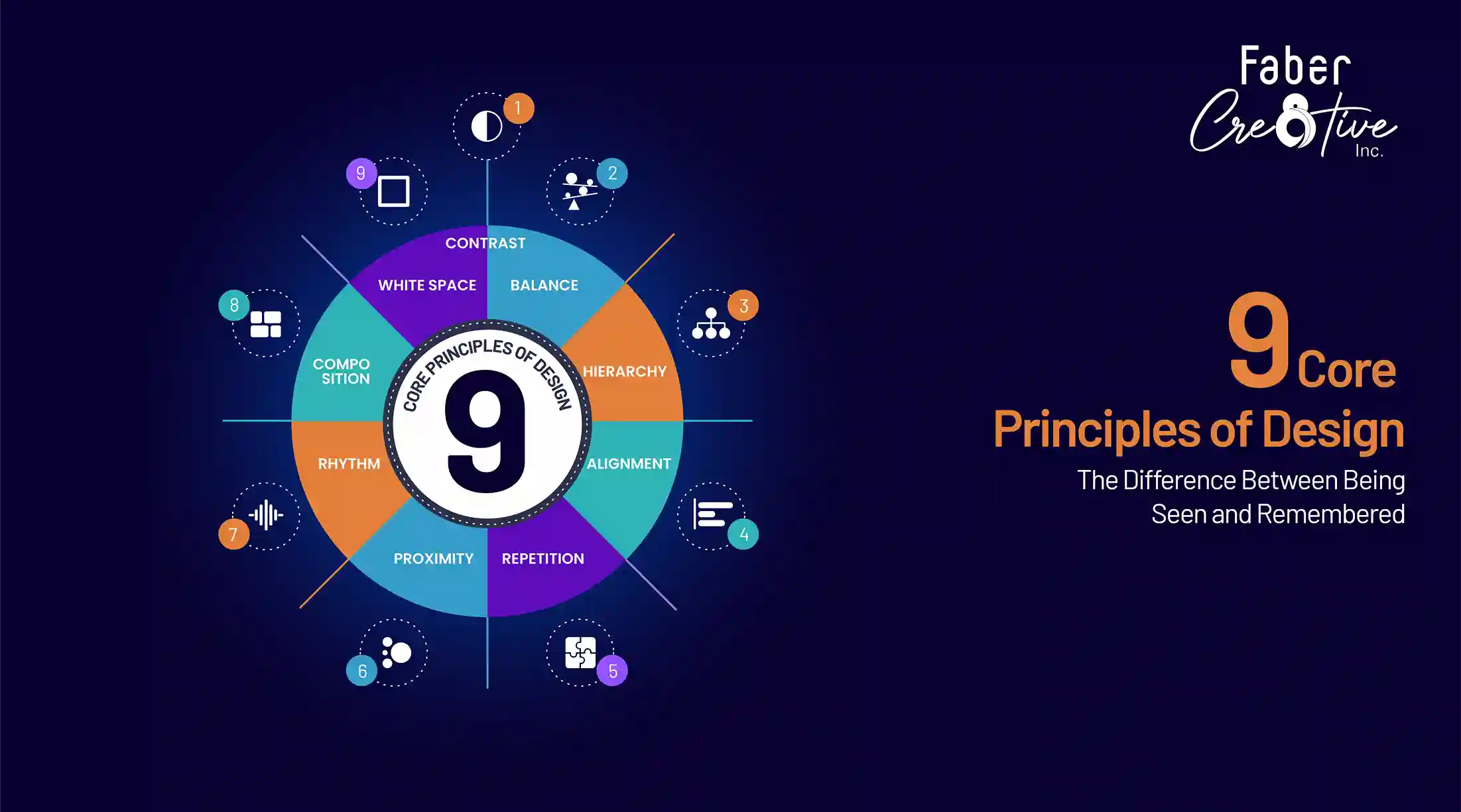
At Faber Cre8tive, we continually remind our clients that great design is not about creating something beautiful. It’s about making them look great! The first step is to understand the 9 steps of design that create all successful visual identities.
Why the Principles of Design Matter
Design impacts your brand before the headline or before someone interacts with your product.
Studies have repeatedly demonstrated that individuals make their judgments and preferences within seconds. In such instances, visual design serves as the first step in beginning your conversation with a potential customer.
These principles aid businesses:
These principles will help you create successful visual communication, whether you’re working on the design of a website, social media campaign, product packaging, or your entire brand.
1. Contrast
Creating Visual Impact
Contrast is the difference between elements. It can be made in a variety of ways, such as colour, size, shape, typography and spacing.
With no contrast, it all blends together. Using it, key data will pop out immediately.
Think about a website’s call-to-action button. Users might not even notice it because it blends seamlessly with everything else. Contrast is an important tool for drawing attention to the most crucial elements.
Without contrast, designs can appear dull, unclear, and confusing.
2. Balance
Creating Stability and Harmony
Balance is the distribution of weight in a design.
A few designs are symmetrical or arranged symmetrically. Some use asymmetrical balance, generating energy and staying grounded.
Suppose you enter a room in which everything is shoved aside. It would be awkward and uncomfortable. The same applies to visual design.
Balanced layouts appear purposeful, polished and reliable. They give an order which helps the audience listen to the message instead of the arrangement.
3. Hierarchy
Guiding the Viewer's Attention
Not all the information is equal.
Hierarchy sets priorities for what users should see first, second and third. It helps to direct people through the information in a logical order.
Professional designers set hierarchy by using size, colour, spacing, typography and placement.
The main message should be conveyed in a website headline. Supporting text/secondary information should flow naturally.
If the hierarchy is not available, then users have to make up their own minds about what is important and what is not. Most won’t stay long enough to figure it out.
4. Alignment
Bringing Order to Design
Elements are connected together invisibly by alignment.
Users may not be aware of the alignment, but it is felt as soon as they use it. Designs that are well aligned look organized, purposeful and finished.
All text blocks, images, icons and buttons should be clearly related to other elements.
When it’s misaligned, it produces visual noise. Even if each of its elements is well designed, it makes the layout look hurried and unprofessional.
Alignment in branding design can make all the difference between looking professional and looking amateurish.
5. Repetition
Building Recognition and Consistency
Repetition strengthens familiarity.
Consistency is achieved by the repetition of colours, fonts, patterns, icons or even visual styles, at each point of contact with the customer.
Think about some of the best-known brands in the world! Consistent visual identities that you encounter on a website, billboard, social media platform or product package.
Repeating your brand name and logos makes them instantly recognizable to the audience.
If there is no repetition, the design becomes broken up. A disconnect is felt in each piece with the overall brand story.
6. Proximity
Organizing Information Naturally
Proximity is arranging elements in close proximity together and keeping unrelated elements apart.
Though it might seem trivial, it is absolutely true that distance plays an important role in how users process information.
For instance, when the contact information is organized under one heading, it seems intuitively obvious. When the phone number, email address and location are spread out on a page, users will have to do more work to locate what they are looking for.
Spatial proximity helps lower cognitive load and increases clarity.
Designs that are unorganized and hard to read can be more than just unattractive; they can be overwhelming, too, and it’s the whole that makes a difference, not its parts.
7. Rhythm
Creating Movement and Flow
In design, rhythm means a sense of movement or energy.
Repeated patterns, spacing and visual cues help to direct viewers along content, like rhythm leads the ear through music.
Rhythm may be simple or complex. It can be presented in a repetitive pattern, uniform spacing or alternating presentation of content structures.
When the website is well designed, the movement of the visitors from one part to another is intuitive and easy, whereas a website looks disjointed and hard to follow without rhythm.
8. White Space
The Power of What Isn't There
White space is one of the most commonly misunderstood principles of design.
A lot of people think that empty space is wasted space. In fact, white space is one of the most useful tools of the professional designer.
White space creates space for breathing. It allows you to separate content, make it more readable, and highlight key elements.
White space is a luxury that’s often used by premium brands as it produces sophistication, focus, and confidence.
Too much information on each square inch of the design can overwhelm the user. The placement of strategic white space enhances important messages.
9. Composition
Bringing Everything Together
The general organization of the elements of the visual design is called composition.
It is the fundamental which is the link to the rest of the principles.
A good composition will take into account contrast, balance, hierarchy, alignment, repetition, proximity, rhythm, and white space in a cohesive system.
It’s like the “choreography” of a performance. Each movement is purposeful, and each element adds to the overall experience.
Beautiful individual elements can also fall apart if the composition is not structured and directed.
How These Design Principles Work Together
The best visual presentation does not depend on any one or two principles.
One site may choose to use hierarchy to focus the viewer’s attention, contrast to draw the viewer’s focus to a specific action, white space for readability, and repetition in order to reinforce brand identity. Take one out, and everything can go wrong.
These principles function as a correlated system.
They can be used creatively to make designs intuitive, engaging and memorable when used well. Even the most aesthetically pleasing work may not be communicate when left unmaintained.
For this reason, an expert designer starts with the structure and works towards the decoration. The best creative answers are those that have been well supported.
Applying These Principles to Your Brand
Improved design basics are applicable to any business.
These principles influence:
More importantly, they have an impact on your users’ perception of credibility, professionalism and value.
Good design is more than just appearance. It is a business tool that will allow organizations to communicate more clearly and connect more effectively with their audiences.
Final Thoughts
Design principles are timeless since they are based on the human visual processing mechanism.
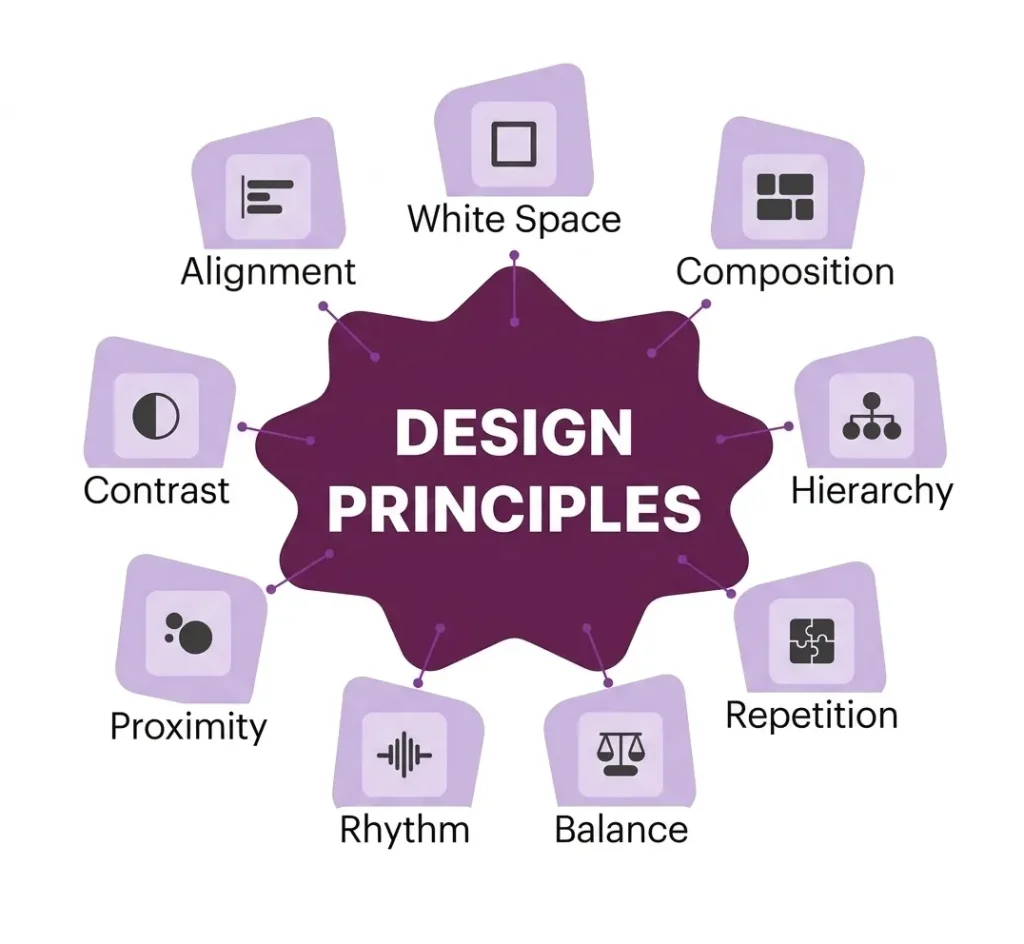
Attention is drawn to contrast. Balance leads to stability. Hierarchy directs focus. Alignment creates order. Repetition fosters recognition. Proximity improves understanding. Rhythm creates flow. White space is a symbol for clarity. Composition is the process of putting everything together.
These principles of design are not rules to be followed. It’s the idea of designing with purpose to create perception and generate impact.
We think the best brands are created on purpose at Faber Cre8tive. Businesses can design experiences that resonate, engage and last when they’re built with a strategy, not a hunch.
Ready to Elevate Your Brand?
From creating a new brand identity to refreshing your website or simply enhancing your visual communication, the right design strategy can make a huge difference. Contact Faber Cre8tive to discover the power of meaningful, strategic design in creating a brand that’s unforgettable.