Not Every Problem Needs a Faster Solution; Some Need a Better Understanding
Most businesses don’t fail because of a lack of ideas, but because they build ideas without truly understanding the people they’re building for.
Design Thinking exists to fix that gap.
It is not a design tool reserved for creatives or UX teams. It is a structured way of thinking that helps businesses, marketers, and innovators solve problems by starting with one simple shift:
Understand people first. Build solutions second.
With so many options available and increasing customer expectations, this is no longer a choice, but a must. This attitude is at the heart of the way modern brands should think, talk and develop at Faber Cre8tive.
At Faber Cre8tive, this mindset sits at the core of how modern brands should think, communicate, and grow.
So, What Exactly Is Design Thinking?
Design Thinking is a human-centred problem-solving process that starts with understanding true human needs and ends with developing solutions.
Rather than starting with:
It starts with:
This shift changes everything, especially in marketing and branding.
Because when you understand people deeply, creativity becomes direction, not guesswork.
Why Gestalt Matters for Modern Branding and Websites
Today, consumers have plenty of options. You have limited attention spans, and there is a lot of competition. When brands build a consistent understanding and distinctive identity, they resonate better.
Think about how you browse the Internet. Even if the information exists on the website, you may leave a site that has a feeling of disorganization because the overall feel of the site is not right. You may even be attracted to a brand that has a premium and deliberate look at each point of contact.
For Canadian businesses, using Gestalt principles helps build stronger emotional connections. It turns scattered marketing efforts into a unified presence that resonates and sticks in memory.
The Core Idea Behind Design Thinking
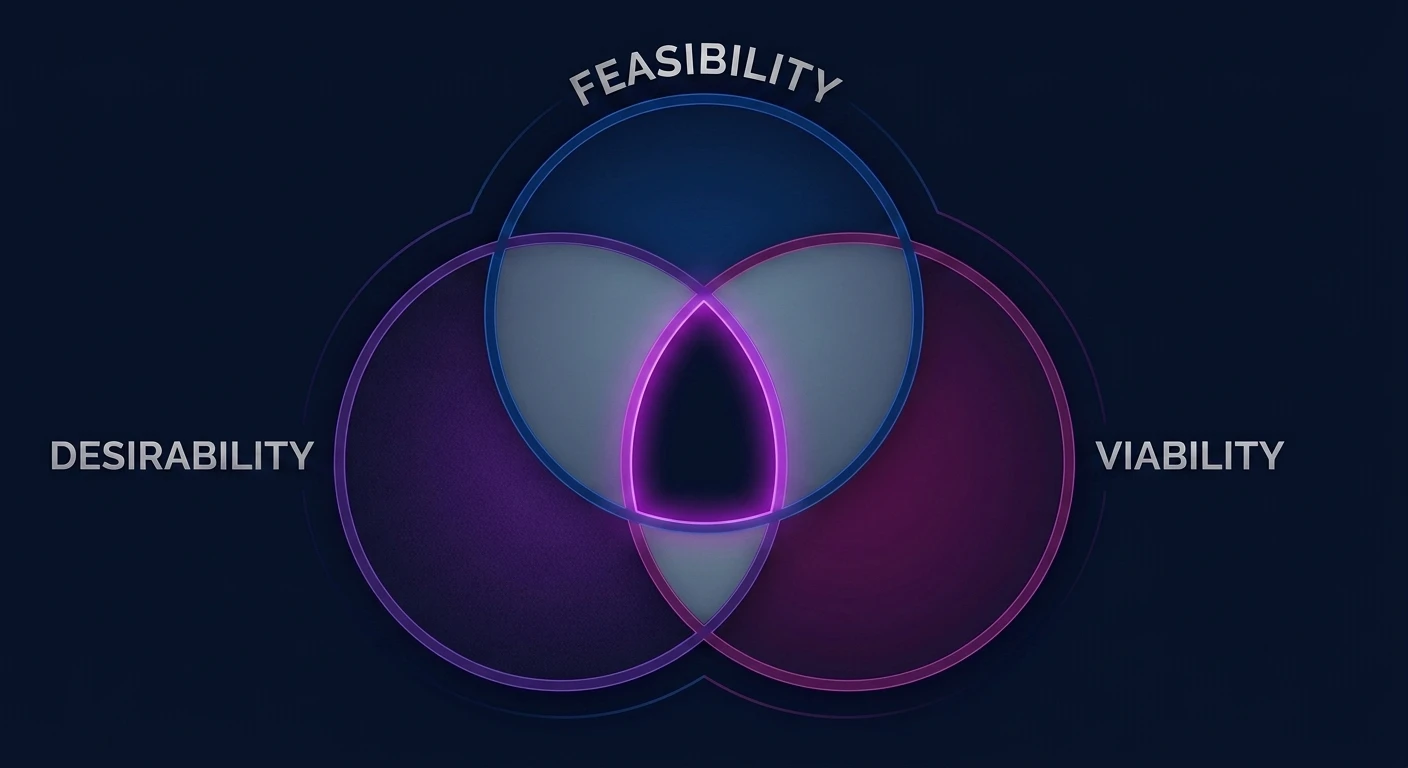
At its simplest, Design Thinking balances three things:
When these three align, meaningful innovation happens in the design department. When they don’t, businesses often end up with products or campaigns that look good but fail to connect.
The Evolution of Design Thinking
Although Design Thinking has become closely associated with innovation and modern business, its roots stretch back several decades.
The concept evolved from research in design theory, psychology, engineering, architecture, and systems thinking. Some of the early scholars noted that designers worked differently with complex problems than do traditional analytical disciplines.
Designed without a single “right” solution, designers considered human behaviour and experimented with solutions to create the best fit.
Nobel Prize-winning scholar Herbert Simon theorized that the essence of design was to change a present situation to a desired one. His work helped to create an understanding of design as a form of structured problem-solving and not just an art form.
During the 1970s, researchers began examining what became known as “wicked problems”, that is, complex challenges that have no clear solution and involve multiple stakeholders, competing priorities, and constantly changing conditions.
Examples include improving customer experiences, reducing healthcare barriers, addressing sustainability challenges, building stronger communities, creating effective digital products, and developing memorable brands. Unlike straightforward technical problems, these challenges require deep understanding, collaboration, and iterative learning.
With the rise in the complexity of customer demands, many companies started solving problems using design-based techniques. The methodology originally adopted by designers eventually spread to product development, customer experience, organizational strategy and marketing.
Today, Design Thinking is used by startups, global enterprises, government organizations, healthcare providers, educational institutions, and marketing agencies to solve complex business challenges while keeping people at the center of decision-making.
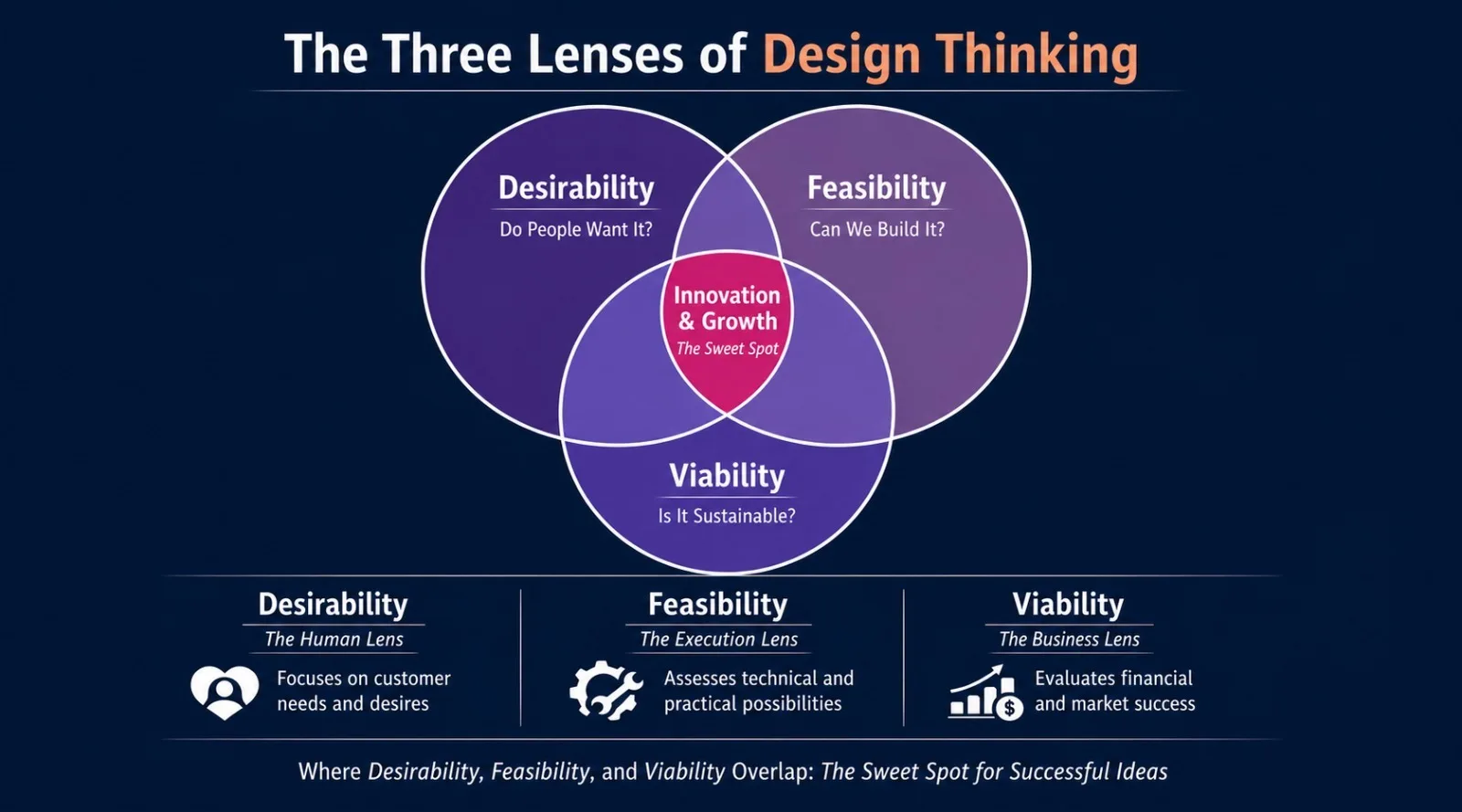
The Three Lenses of Design Thinking
One of the most important yet often overlooked aspects of Design Thinking is how ideas are evaluated before they are brought to life. Instead of relying on assumptions or internal preferences, Design Thinking introduces three core lenses that help determine whether an idea is truly worth pursuing in the real world.
1. Desirability: The Human Lens
Desirability focuses entirely on people. It asks a simple but critical question: Do people actually want or need this?
This lens is rooted in understanding real human behaviour, emotions, motivations, and frustrations. It goes beyond surface-level demographics and focuses on what truly drives decisions. In marketing terms, desirability is where relevance is built. If a solution does not connect with people on a human level, no level of execution can make it successful in the long run.
2. Feasibility: The Execution Lens
The next step is feasibility, which involves determining whether an idea is viable in the real world. It considers the available tools, technology, resources, skills, timelines and operational capacity of an organization. No matter how exciting or promising an idea may be, if it cannot be implemented successfully, it will be worth nothing.
By using this, innovation can stay focused on reality, and ideas can go from theory to practice.
3. Viability: The Business Lens
Viability ensures that an idea makes sense from a business perspective. It evaluates whether the solution can generate sustainable value, support long-term growth, and align with overall business objectives.
Ideas can be desirable to the customers, feasible to build, but if they are not financially and/or strategically sustainable, they cannot be successful when scaled. This lens is for making creativity and commercial reality go hand-in-hand.
Where the Three Lenses Meet
The best ideas are where desirability, feasibility and viability converge. This is where solutions are innovative, scalable, sustainable, and creative. Once all three lenses are aligned, they are not just operating on a guesswork basis but also moving into structured decision-making. This is where marketing gets more focused, and innovation is more consistent.